

The Event Pipeline is our biweekly read on what’s changing across events, AI, and go-to-market, including what we’re hearing directly from event and field marketers, practical workflows to try, industry trends, and who’s hiring.
For our first issue, we’re starting with one of the most consistent themes coming out of our own conversations with event marketers: proving event ROI.
In 16 of our last 29 sales and prospect calls, the same pain came up unprompted. Event marketers couldn’t clearly show what their events returned.
One person told us she had been chasing the answer for her entire career.
Most of the insights below come directly from conversations our team has been having with event and field marketers. We’ve added outside research where it helps put those conversations in context.
Event ROI goes cold in the CRM
An executive events lead at a 100,000-person software company told us:
“It’s something that honestly I’ve been trying to get at my entire career and have yet to get there.”
A marketing lead at a 200-person advertising company used a $2 million yacht event as an example. If $20 million in closed business followed, how would anyone actually know what role the event played?
Almost nobody we spoke with described this as an event data capture problem.
The trail tended to break later.
A field marketer at a 165-person software company told us sales could change attribution after the fact. Their 18-month sales cycle also outlasted the window being used to attribute the event.
An events marketer at a 500-person AI services company put it plainly:
“This report would only be as accurate as the data entered in our Salesforce.”
That distinction matters.
Event marketing ROI is often treated as a reporting problem, but the dashboard is only the last step. If event engagement is poorly logged, attribution can be changed later, or the measurement window doesn’t match the actual sales cycle, the reporting layer never had a chance.
Our sample is biased. These are people who agreed to talk to an events platform, so many of them are more likely to already feel this pain.
But outside research suggests the problem is much broader.
Vendelux raised $50 million in July to build what it calls an events system of record. Its founder argues that companies put close to a third of marketing spend into events while still struggling to prove what comes back.
That’s a founder claim, with a founder’s incentive to emphasize the problem. But the underlying issue closely matches what we’ve been hearing directly from event marketers.
Three ways to pressure-test your event attribution
- 1Audit your last three events. How many closed-won deals contain an event touch? If the answer is zero, start by checking whether those touches are actually being logged.
- 2Review attribution permissions. If attribution can be changed after a deal closes, how stable is the number you’re reporting?
- 3Compare your attribution window with your sales cycle. If your sales cycle is 18 months and your attribution window is 90 days, a large portion of event influence may never appear.
The list dies at the handoff
The next failure point we kept hearing about happens after the event.
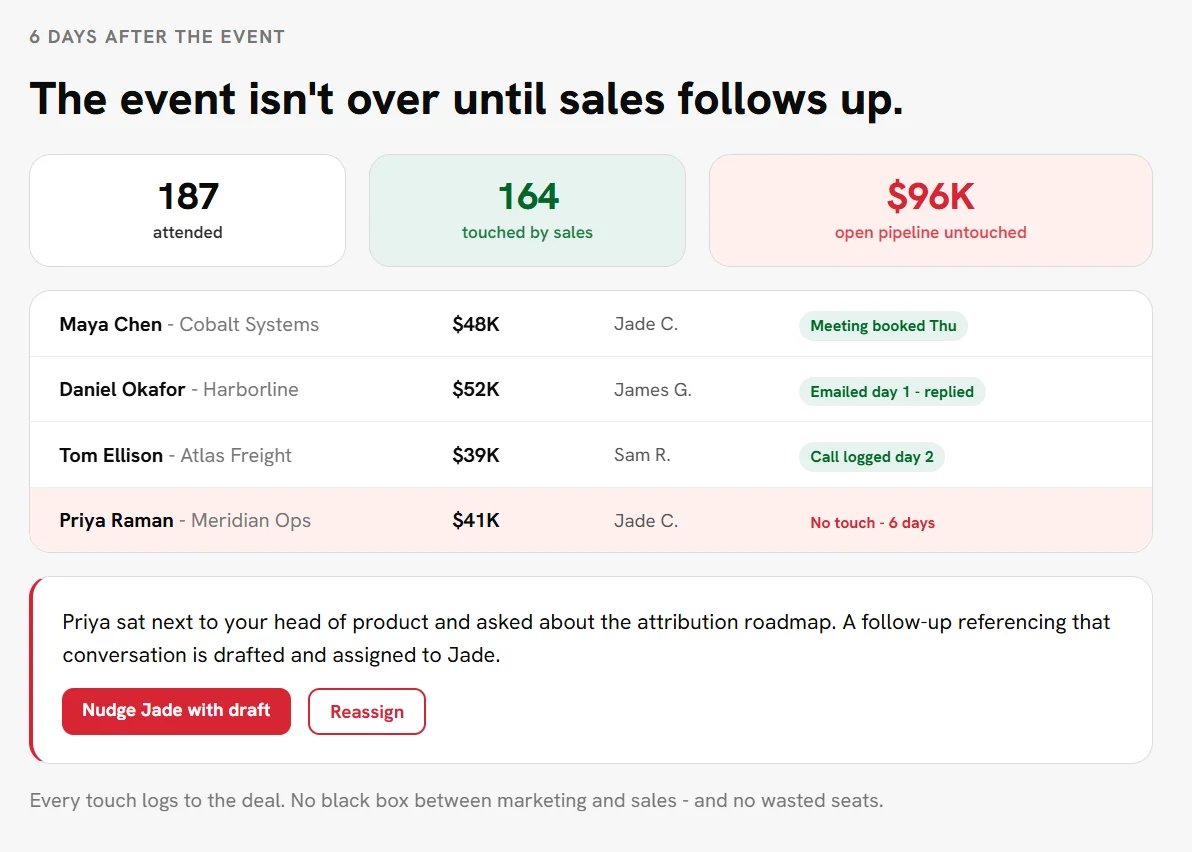
At a 1,000-person compliance software company, the events team pulled its attendee list from Salesforce, sent it to sales in Excel, and asked reps to mark who they planned to follow up with.
“No one did,” the marketer told us.
At another company with more than 1,000 employees, the process was much more structured. Follow-up tasks were created and assigned.
Still, only about 20% of those tasks were completed.
The events lead described everything that happened after the event as a “black hole.”
The two companies had different processes, but the same underlying problem.
The attendee list made it to sales. What happened next was much harder to see.
LeanData found a similar pattern in a survey of 201 senior enterprise RevOps leaders. Forty-five percent cited slow or missed follow-up, while 42% cited disagreement on qualification.
The difficult part usually isn’t writing the follow-up email.
It’s preserving the context around the person:
Who did they speak with? Why did the conversation matter? Who owns the next step? When is it due? Was it actually completed? Did the action make it back into the CRM?
Once any of those links break, event engagement becomes much harder to connect to pipeline.
We broke this down further in our post-event follow-up framework, including the seven pieces of context that need to survive the handoff from the event to sales.
The export step is starting to disappear
There’s another shift happening at the same time.
MCP lets AI agents connect directly to software. Skift reports that RainFocus and Swoogo are among the early event-tech adopters, while Salesforce now exposes Agentforce Marketing campaign management as MCP tools.
In theory, that means fewer CSV exports and fewer manual transfers between event tools and the CRM.
But in our conversations with event marketers, the more interesting question has been trust.
During one demo, an events marketer at a 500-person AI services company asked us:
“How much your tool is just fetching data from our toolset and how much it is its own toolset.”
That’s the right question.
Once an AI agent can reach registration and CRM data without an export, teams need to understand what it can access, what it can change, and who reviews the output.
The opportunity isn’t to give AI free rein over attendee data. It’s to remove some of the spreadsheet shuffle while maintaining control over the underlying data and workflow.
A post-show CRM workflow to try
One experiment event teams can already run today is AI-assisted post-event triage.
HubSpot can run an AI agent inside a workflow and write the result back to the contact record.
That creates a relatively simple post-show experiment.
Send scanned contacts into a workflow. Use an agent to fill in missing company information, read the rep’s booth note, and assign each contact a priority tier with a short explanation.
- Tier A
Create a same-day sales task.
- Tier B
Add the contact to a follow-up sequence.
- Tier C
Send the contact to nurture.
Then test it.
Triage half your scans manually and run the other half through the workflow. Compare the 48-hour touch rate and meetings booked.
The workflow requires HubSpot Professional or Enterprise and HubSpot Credits. The Run Agent action is capped at 500 executions per day, and its output will only be as useful as the information going into it.
There’s also one setting worth checking before your next event import.
Ask RevOps whether your account has a marketing-contact limit. Once the limit is reached, HubSpot can set additional contacts as non-marketing, which can stop parts of your follow-up from running.
Ask before the import, not after.
Event marketing jobs we’re watching
- StealthWatchEvent Marketing Manager, New York, $200,000. “Pipeline” appeared three times in the posting.
- EndraFounding Content & Events Marketing Lead, San Francisco, $180,000 to $220,000. The role decides where the company should and should not invest.
- RogoField Marketing Manager, New York, $150,000 to $225,000. Owns an ongoing event budget.
- GustoEvent Marketing Manager, San Francisco, $154,000 to $188,000. Requires AI fluency across the event lifecycle.
- NeticFounding Field & Event Marketer, San Francisco. Owns the full health of the program.
- PalletField Marketing Manager, San Francisco, $100,000 to $140,000. Runs more than 20 events a year on tight turnarounds.
- Fireworks AIField Marketing Manager, Startups, San Mateo. A founding role with Salesforce proficiency required.
One pattern stood out in this batch: the highest salary bands belonged to roles that owned a number or a budget, not only logistics.
Two AI companies were hiring founding event marketers, while Gusto explicitly listed AI fluency alongside production experience.
The event marketing role is increasingly splitting between execution and strategy. One of the biggest differences is the number you’re expected to own.
Three reads for event marketers
How to run AI agents inside HubSpot workflows
HubSpot’s guide to calling an AI agent from a workflow and saving its output to a contact record. Useful if you want to experiment with the post-show triage workflow above.
Do Meta glasses belong at private events?
Skift looks at what wearable cameras could mean for closed-door meetings, customer dinners, and other private event formats.
Why attendees want more time outside formal sessions
Freeman found that attendees would ideally spend 54% of their learning time outside formal sessions, rising to 64% at trade shows. It’s another signal that conversations and smaller interactions increasingly matter alongside formal programming.
What happened to the list after your last event?
That’s the question we kept coming back to while putting together our first issue.
Did the attendee data make it into the CRM? Did sales know who mattered? Did someone own the next action? And a few months later, could anyone connect what happened in the room to a business outcome?
Those are the questions we’ll keep exploring in The Event Pipeline, using what we’re hearing directly from B2B event and field marketers alongside the broader shifts happening across events, AI, and go-to-market.
Get The Event Pipeline in your inbox
The Event Pipeline is a biweekly newsletter on what’s changing across events, AI, and go-to-market: firsthand insights from event marketers, practical experiments and workflows, industry signals, and who’s hiring.
