

The Event Pipeline is a biweekly read on what’s changing in the event marketing space: the signals worth paying attention to, what we’re hearing internally, experiments to steal, and who’s hiring.
In Issue #2 of The Event Pipeline, we’re digging into three shifts in B2B event marketing: why one team screened 550 registrations down to 33 accepted seats, where post-event follow-up keeps breaking, and what Apple Watch conversation summaries could mean for event privacy.
Plus, what 20 event marketers shared over dinner in NYC, why planners are revisiting hotel contracts, how AI is complicating measurement, and who’s hiring in event and field marketing.
Conference attendees are going to fewer sessions. One-on-one and small-group meetings are up.
Average session attendance fell from 5.3 sessions per attendee in spring 2025 to 4.2 in spring 2026, while event teams are hosting up to 3x more corporate meetings, according to RainFocus.
Smaller formats are growing, too: 36% of companies surveyed at the end of 2025 planned more ancillary events, roadshows, and webinars in 2026, while small-event attendance increased 6.4% year over year.
Takeaway: Attendees seem to be prioritizing what they can’t get from a recording or AI recap, and that’s actual time with other people.
Event teams are cutting 550 registrations down to 33 seats, on purpose
One field marketing team told us it screened roughly 550 public registrations for a New York event down to about 33 accepted seats. Of the 18 who attended, the team can trace one opportunity back to the event.
Five field marketers told us in the last two weeks that open registration often fills rooms with people who are unlikely to buy. They want more of the screening automated, including auto-declines based on job title, flags for repeat free-event registrants, and minimum quality thresholds.
Takeaway: Curation is shifting from an individual skill to a product requirement. It’s the same broader shift showing up in RainFocus data from the attendee side, and in some of the job postings below.
What 20 event marketers told us over dinner in NYC
We recently brought 20 event and field marketing leaders together for a private dinner at Upland in New York, with guests from Zapier, Vercel, AdRoll, monday.com, Locala, Croud and more.
The food was delicious, the ambiance was perfect, and everyone showed up and showed out in style. More than anything, the small room gave people time to really talk about what’s working in events, and what’s absolutely not.
New introductions turned into long side conversations, people exchanged LinkedIn and IG handles, and there was a real sense of “Wait, you deal with this too?”
By the end of the night, it felt like a room full of people who had found their people. A beautiful evening, a lot of honest conversations, and some genuinely lovely new connections.
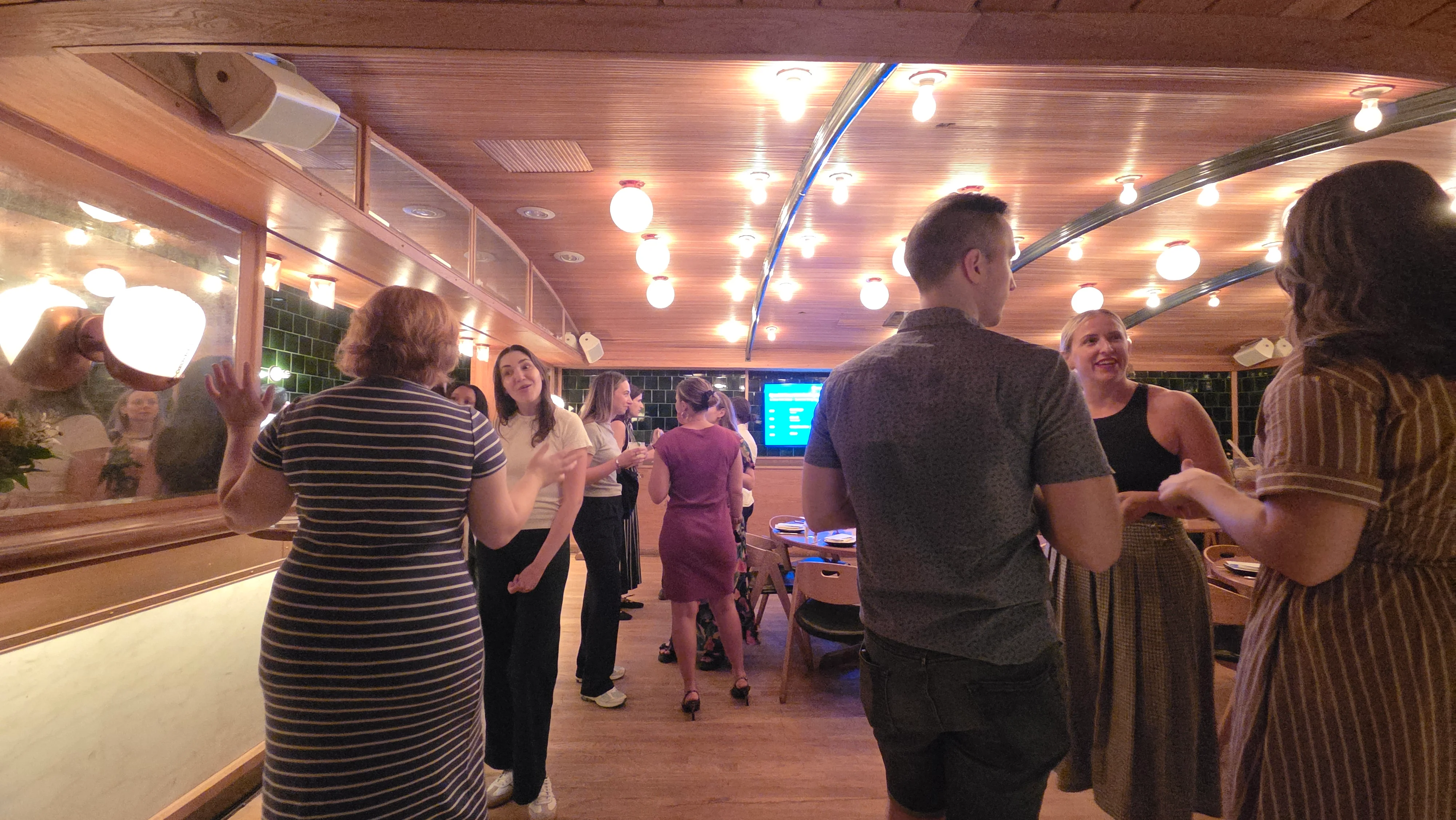
Event and field marketers at an EpochX dinner in New York City.
Read the NYC Event Marketing Salon recap
Five buyers in two weeks pointed at the same failure: post-event breakdown
Here are a few of the internal signals we’ve been hearing:
One team running roughly 40 U.S. events between July and November described sales follow-up and conversion tracking as close to nonexistent. Another named seller-side lead reconciliation as its top operational priority.
Spending more hasn’t fixed it. One team paid for a premium registration tier to get API access, connected it to their workspace, and still manages attribution manually in spreadsheets.
Takeaway: Post-event follow-up is a multi-week workflow being managed by tools built for a single moment. The marketing email goes out on time. The personal follow-up often doesn’t.
Half of corporate planners have changed their hotel contracts
In a Skift Meetings survey of 111 in-house corporate planners, half said they had revised their contract language in the past two years. Cancellation and rebooking terms, force majeure, and attrition are among the biggest areas being revisited. Cyber and AI liability are starting to enter the conversation too.
One sourcing professional described a state of emergency that knocked out power in a host city, and the hotel still billed the organizer for attrition.
Takeaway: Event risk changed faster than the paperwork, and half of the surveyed planners have caught up. If your contract language hasn’t moved in a few years, you may be carrying risk your peers have already negotiated away.
Read Skift Meetings on hotel contracts
IAB raised its 2026 ad-spend forecast to 12.3% growth while marketers say AI is changing measurement
IAB raised its 2026 U.S. ad-spend growth forecast from 9.5% to 12.3%.
Meanwhile, 86% of surveyed ad buyers say conversational AI and AI agents are already changing, or will soon change, how they measure media. Forty-eight percent now measure brand visibility and citations directly inside AI tools.
Takeaway: Events already have a measurement problem, but now the rest of marketing is wrestling with the same question: how do you prove what worked when more channels and AI sit between exposure and action?
Read IAB’s 2026 ad-spend forecast
Apple Watch will be able to recap conversations. What does that mean for private events?
Apple says Siri Recap, an opt-in feature for Apple Watch Series 12 and Ultra 4, will generate high-level conversation summaries without saving recordings or full transcripts. Apple says the beta will arrive later in 2026; it is not available yet.
Most event recording policies were written for phones, cameras, and obvious recording devices, not smart watches.
Takeaway: For executive dinners, advisory boards, and closed-door sessions, the question may no longer be just “Are attendees allowed to record?” You may need to set an explicit device policy before this feature arrives.
Read Apple’s explanation of Siri Recap
The FBI warns against fake event invitations that can bypass MFA
The FBI issued an alert about OAuth consent phishing, where victims authorize a malicious app instead of handing over a password.
The technique can bypass MFA, and password resets may not remove the attacker’s access. Previous campaigns have impersonated event coordinators and planners.
Takeaway: Your attendees may not be able to tell your invite from a fake. Consider publishing the exact domains you send from.
Read the FBI alert on OAuth consent phishing
Who’s hiring in event and field marketing?
Ten roles we found at the linked listings on September 29, 2026. Openings and compensation can change.
- StackOne: Demand Generation & Field Marketing Specialist, San Francisco / remote, $90K–$115K.
- OpenArt AI: Strategic Events Manager, San Carlos, CA, with an initial focus on Los Angeles and New York; $140K–$170K.
- KPMG US: Manager, Events Marketing, Silicon Valley, San Francisco, $96.6K–$185K California range.
- ElevenLabs: Events Lead, North America, location and compensation on posting.
- Runway: Event Marketing Manager, New York / remote, $130K–$175K.
- Motive: Partner and Public Sector Events Marketing, Austin hybrid or remote for the right candidate; $54K–$75K for most U.S. locations, $62K–$86K in San Francisco.
- Coder: Field Marketing Manager, New York City / remote, $110K–$149K.
- Norm Ai: Senior Field ABM & Events Manager, New York City / hybrid, $140K–$180K.
- Factory: Field Marketing, East, New York / on-site.
- Enclave: Field Marketing Manager, New York City / hybrid.
Curious pattern: Some event manager jobs are splitting into strategy and delivery roles with different pay. StackOne keeps logistics with a dedicated events manager so this hire can focus on the audience and narrative, while Motive’s listing is explicitly the operations half. KPMG splits it a third way between a market-facing manager and a separate execution team.
AI literacy is also showing up as an explicit expectation in some listings. Several of these roles mention target-account planning or curated guest lists: deciding who gets in the room is becoming a strategic responsibility, not just a logistical one.
Get The Event Pipeline in your inbox
The Event Pipeline is our biweekly read on B2B event and field marketing: firsthand insights from event teams, practical workflows, industry trends, experiments, and open roles.
Subscribe below to get the next issue.
